Audience retention shows which moments of a video kept viewers watching. Watch time is the total time people spent watching. Impressions click-through rate (CTR) is how often a thumbnail shown on YouTube turned into a view. Each answers a different question: did people click, did they stay, and how much did they watch in total. YouTube recommends judging them together rather than chasing any one of them.
Key points
- CTR is about the click: thumbnail, title and how well they match the viewer.
- Retention is about the content: the intro, pacing and the moments people skip.
- Watch time is the total: views multiplied by how long people watched.
- YouTube says half of all channels and videos have an impressions CTR between 2% and 10%.
- High CTR with low view duration is the pattern YouTube associates with clickbait.
What is the difference between retention, watch time and CTR?
| Metric | What it measures | Where to find it |
|---|---|---|
| Impressions CTR | How often viewers watched after seeing a registered thumbnail impression | Reach tab |
| Audience retention | How well each moment of the video held viewers | Overview or Engagement tab (video level) |
| Average view duration | Average minutes watched among those who stayed to watch, calculated from engaged views and their watch time | Engagement tab |
| Watch time (hours) | Total time viewers watched your video | Engagement tab and channel Overview |
Note: since August 24, 2026, YouTube counts a public view as soon as a video starts to play, across all formats. Average view duration and other engagement metrics are still based on engaged views (viewers who clicked to watch or kept watching past the first moments). That means a rise in public views doesn’t dilute your average view duration.
What is a good click-through rate on YouTube?
YouTube doesn’t set a target. It says half of all channels and videos have an impressions CTR between 2% and 10%. Newer videos and videos with under 100 views can show an even wider range. CTR naturally drops when a video gets many impressions, for example on the Home page, and tends to be higher when most impressions come from your own channel page.
YouTube’s advice is to compare CTR between your own videos over the long term, allow for differences in traffic sources, and wait for a substantial number of impressions before acting. Don’t react to small swings, and don’t check CTR straight after uploading.
What does the audience retention graph tell me?
The graph shows the share of viewers still watching at each point. YouTube highlights four kinds of moments:
| Shape | What it means |
|---|---|
| Flat line | Viewers are watching that part from start to finish |
| Gradual decline | Viewers are losing interest over time (normal for most videos) |
| Spike | More viewers are watching, rewatching or sharing that part |
| Dip | Viewers are skipping or leaving at that point |
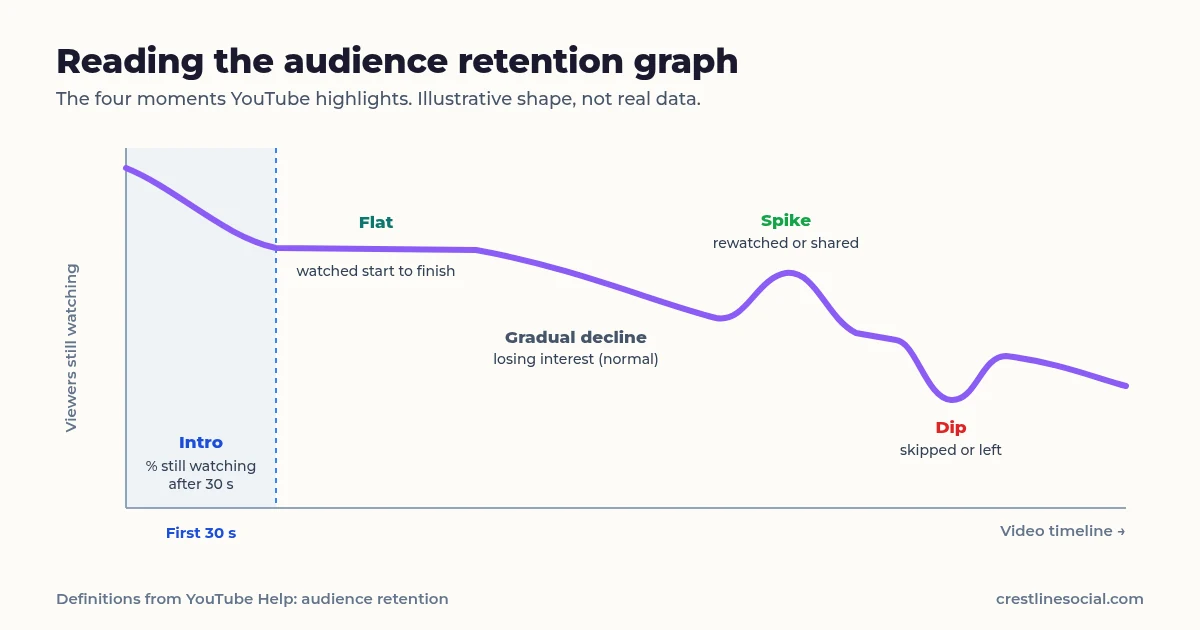
The Intro figure shows what percentage of viewers were still watching after the first 30 seconds. If it is low, YouTube suggests making the thumbnail and title match the content better, or reworking the opening. Key moments only appear on videos that are at least 60 seconds long with at least 100 views, and retention data typically takes 1 to 2 days to process.
How to open it (desktop)
- Sign in to YouTube Studio and select Content.
- On the video, select Analytics.
- Open the Overview or Engagement tab and find Audience retention.
- Use Segments to compare new and returning viewers, or subscribers and non-subscribers.
On mobile
In the YouTube Studio app, open the video from Content, tap the Analytics card and use the tabs at the top. YouTube notes some reports may not be available on mobile.
How do the three metrics work together?
| Pattern | Likely meaning | What to try |
|---|---|---|
| High CTR, low view duration | The packaging over-promises (YouTube’s clickbait signal) | Make the title and thumbnail accurate; deliver the promise early |
| Low CTR, high view duration | Good video that people aren’t clicking | Test a clearer thumbnail and title |
| Good CTR, sharp early dip | The intro loses people | Cut the preamble and get to the point within the first 30 seconds |
| Spikes mid-video | A moment people rewatch or share | Make more content like it, or move it earlier |
YouTube says it recommends videos that are relevant to viewers and whose average view duration shows people find them interesting. Clickbait tends to have low view duration, so it is less likely to be recommended. Watch time also matters for the Partner Program, which uses public watch hours as one route to eligibility. See how long it takes to get 4,000 watch hours.
Can I buy watch time or CTR?
YouTube’s fake engagement policy prohibits artificially increasing views, watch time and other metrics, and artificial traffic isn’t counted. If you are considering services like our watch hours, weigh that policy risk first. Packaging and retention improvements are the levers YouTube rewards. To see where your views come from before changing anything, read YouTube traffic sources explained, or get a quick snapshot of any public video with our YouTube video analytics tool.
To get enough traffic for these numbers to mean anything on a new video, our free YouTube views trial is a quick way to seed it.
Sources
- YouTube Help: Measure key moments for audience retention
- YouTube Help: Impressions and click-through rate FAQs
- YouTube Help: Understand your video reach
- YouTube Help: Fake engagement policy
- YouTube Help: Understand your YouTube engagement (metric definitions)
- YouTube Official Blog: What are engaged views on YouTube?
FAQ
What is audience retention on YouTube?
A report showing how well each moment of your video held viewers’ attention, including what percentage were still watching after the first 30 seconds.
What is a good CTR on YouTube?
YouTube says half of all channels and videos have an impressions CTR between 2% and 10%. Compare your own videos over time instead of chasing a fixed number.
Is watch time or retention more important?
They measure different things. Retention shows where viewers leave, and watch time is the total watched. Improving retention usually increases watch time as well.
Why is my retention data missing?
Retention data typically takes 1 to 2 days to process, and key moments need a video at least 60 seconds long with at least 100 views.
Does clickbait help CTR?
It can raise CTR, but YouTube says clickbait tends to have low average view duration and is therefore less likely to be recommended.